This page was generated from
doc/examples/MatchHistory - Home advantage.ipynb.
You can download the notebook,
You can download the notebook,
[2]:
import soccerdata as sd
[3]:
%matplotlib inline
%config InlineBackend.figure_format = 'retina'

import pandas as pd
import seaborn as sns

sns.set_context("notebook")
sns.set_style("whitegrid")
Home team advantage in the Italian Serie A
We all know sports teams have an advantage when playing at home. Here’s a look at home team advantage for 5 years of the Serie A.
[4]:
seriea_hist = sd.MatchHistory("ITA-Serie A", range(2018, 2023))
games = seriea_hist.read_games()
games.sample(5)
[4]:
| date | home_team | away_team | FTHG | FTAG | FTR | HTHG | HTAG | HTR | HS | ... | AvgC<2.5 | AHCh | B365CAHH | B365CAHA | PCAHH | PCAHA | MaxCAHH | MaxCAHA | AvgCAHH | AvgCAHA | |||
|---|---|---|---|---|---|---|---|---|---|---|---|---|---|---|---|---|---|---|---|---|---|---|---|
| league | season | game | |||||||||||||||||||||
| ITA-Serie A | 2223 | 2023-05-20 Cremonese-Bologna | 2023-05-20 14:00:00 | Cremonese | Bologna | 1 | 5 | A | 0 | 3 | A | 13 | ... | 1.8 | 0.50 | 1.84 | 2.06 | 1.85 | 2.08 | 1.90 | 2.15 | 1.83 | 2.03 |
| 2021 | 2020-12-06 Crotone-Napoli | 2020-12-06 17:00:00 | Crotone | Napoli | 0 | 4 | A | 0 | 1 | A | 4 | ... | 2.3 | 1.25 | 1.99 | 1.94 | 1.98 | 1.94 | 2.03 | 1.96 | 1.96 | 1.90 | |
| 1819 | 2019-05-26 Fiorentina-Genoa | 2019-05-26 12:00:00 | Fiorentina | Genoa | 0 | 0 | D | 0 | 0 | D | 5 | ... | NaN | NaN | NaN | NaN | NaN | NaN | NaN | NaN | NaN | NaN | |
| 2021 | 2020-11-01 Udinese-Milan | 2020-11-01 11:30:00 | Udinese | Milan | 1 | 2 | A | 0 | 1 | A | 7 | ... | 2.0 | 0.50 | 1.95 | 1.98 | 1.93 | 1.99 | 1.99 | 2.01 | 1.93 | 1.94 | |
| 1819 | 2019-03-10 Frosinone-Torino | 2019-03-10 12:00:00 | Frosinone | Torino | 1 | 2 | A | 1 | 0 | H | 9 | ... | NaN | NaN | NaN | NaN | NaN | NaN | NaN | NaN | NaN | NaN |
5 rows × 121 columns
[5]:
def home_away_results(games: pd.DataFrame):
    """Returns aggregated home/away results per team"""
    res = pd.melt(
        games.reset_index(),
        id_vars=["date", "FTR"],
        value_name="team",
        var_name="is_home",
        value_vars=["home_team", "away_team"],
    )

    res.is_home = res.is_home.replace(["home_team", "away_team"], ["Home", "Away"])
    res["win"] = res["lose"] = res["draw"] = 0
    res.loc[(res["is_home"] == "Home") & (res["FTR"] == "H"), "win"] = 1
    res.loc[(res["is_home"] == "Away") & (res["FTR"] == "A"), "win"] = 1
    res.loc[(res["is_home"] == "Home") & (res["FTR"] == "A"), "lose"] = 1
    res.loc[(res["is_home"] == "Away") & (res["FTR"] == "H"), "lose"] = 1
    res.loc[res["FTR"] == "D", "draw"] = 1

    groups = res.groupby(["team", "is_home"])
    win = groups.win.agg(["sum", "mean"]).rename(columns={"sum": "n_win", "mean": "win_pct"})
    loss = groups.lose.agg(["sum", "mean"]).rename(columns={"sum": "n_lose", "mean": "lose_pct"})
    draw = groups.draw.agg(["sum", "mean"]).rename(columns={"sum": "n_draw", "mean": "draw_pct"})

    res = pd.concat([win, loss, draw], axis=1)
    return res
[6]:
results = home_away_results(games)
results.head(6)
[6]:
| n_win | win_pct | n_lose | lose_pct | n_draw | draw_pct | ||
|---|---|---|---|---|---|---|---|
| team | is_home | ||||||
| Atalanta | Away | 52 | 0.547368 | 16 | 0.168421 | 27 | 0.284211 |
| Home | 56 | 0.589474 | 23 | 0.242105 | 16 | 0.168421 | |
| Benevento | Away | 10 | 0.263158 | 18 | 0.473684 | 10 | 0.263158 |
| Home | 4 | 0.105263 | 20 | 0.526316 | 14 | 0.368421 | |
| Bologna | Away | 22 | 0.231579 | 48 | 0.505263 | 25 | 0.263158 |
| Home | 35 | 0.368421 | 29 | 0.305263 | 31 | 0.326316 |
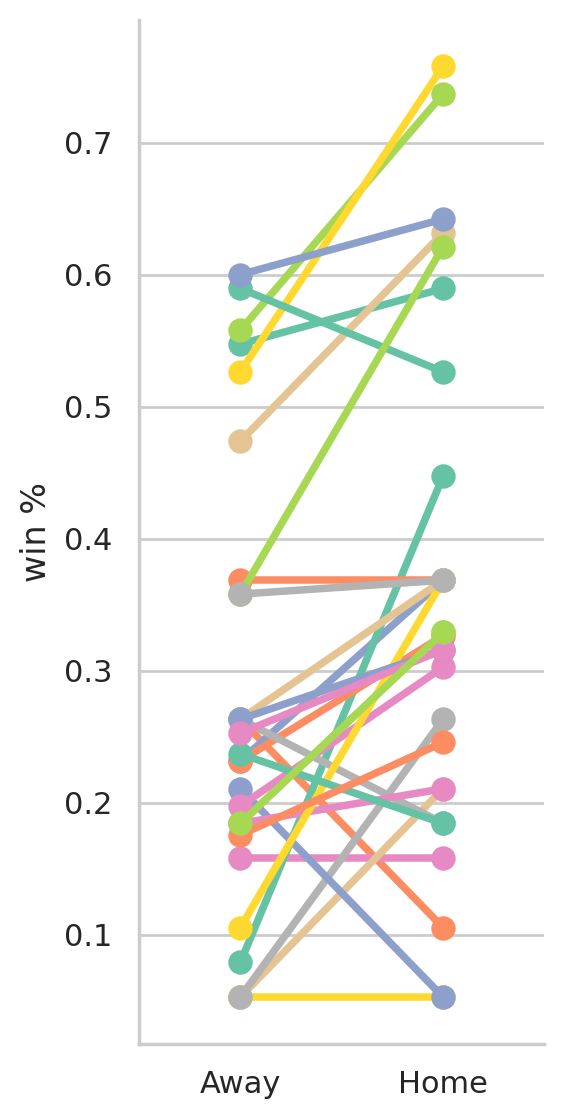
The overall picture shows most teams have a clear advantage at home:
[7]:
g = sns.FacetGrid(results.reset_index(), hue="team", palette="Set2", height=6, aspect=0.5)
g.map(sns.pointplot, "is_home", "win_pct", order=["Away", "Home"])
g.set_axis_labels("", "win %");
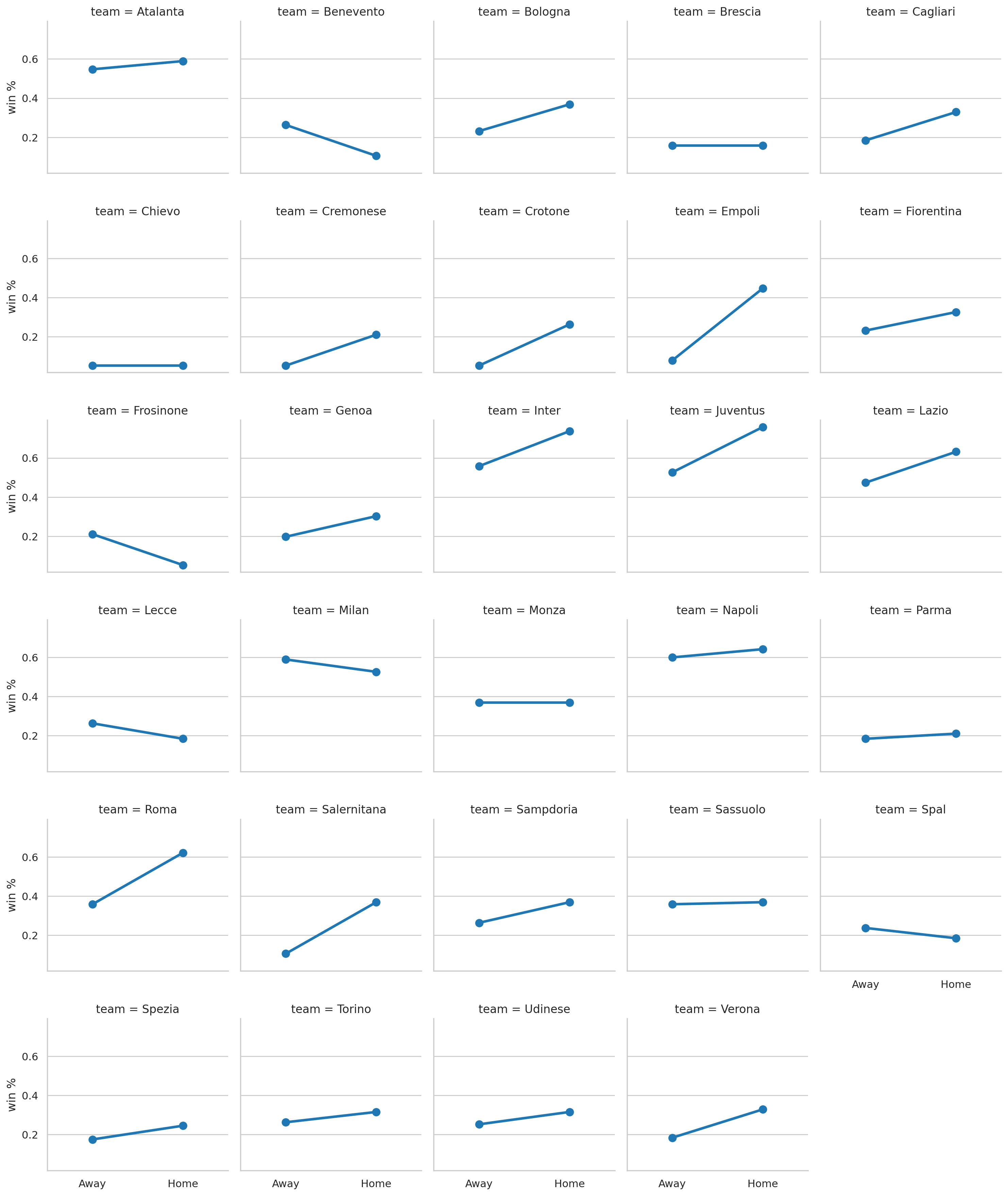
But there are a few exceptions.
[8]:
g = sns.FacetGrid(results.reset_index(), col="team", col_wrap=5)
g.map(sns.pointplot, "is_home", "win_pct", order=["Away", "Home"])
g.set_axis_labels("", "win %");